Your system is running beyond capacity.
It’s time to rebuild capacity, not just treat symptoms.
The Staff Sustainability System™ is a proven framework to stabilize your workforce under chronic demand.
Designed for mission-driven organizations facing relentless pressure — from trauma-impacted contexts to high-demand operational environments.
Leaders begin seeing measurable improvements in team stability and performance within just a few months with intentional capacity work.

Most burnout prevention efforts don't last.
(And it isn't for lack of effort.)
Leaders are doing everything they can to support their teams. From appreciation events to wellness perks, you’ve likely tried multiple ways to boost morale and ease stress—and those efforts matter.
If burnout and turnover still feel relentless, it’s because the system you’re relying on wasn’t built for chronic pressure.
You don’t need more surface-level fixes — you need structural capacity stabilization.
But it doesn't have to stay like this any longer.
The good news is burnout, low morale, and permanent crisis mode aren't permanent—and they aren't inevitable.
With the right approach, leaders can shift from constantly putting out fires to building teams that are steady, engaged, and committed.
The Staff Sustainability System™ was designed for organizations operating where pressure outpaces capacity.
It gives leaders a clear, step-by-step roadmap to address the root causes of burnout, restore trust and safety, and create a culture where staff want to stay.

Introducing the Staff Sustainability System™
(A Proven System to Increase Organizational Capacity)
This system stabilizes teams, strengthens leadership capacity, and embeds practices shown to cut turnover costs by up to 40% within 18 months.
Want the details? Learn more about each stage here.
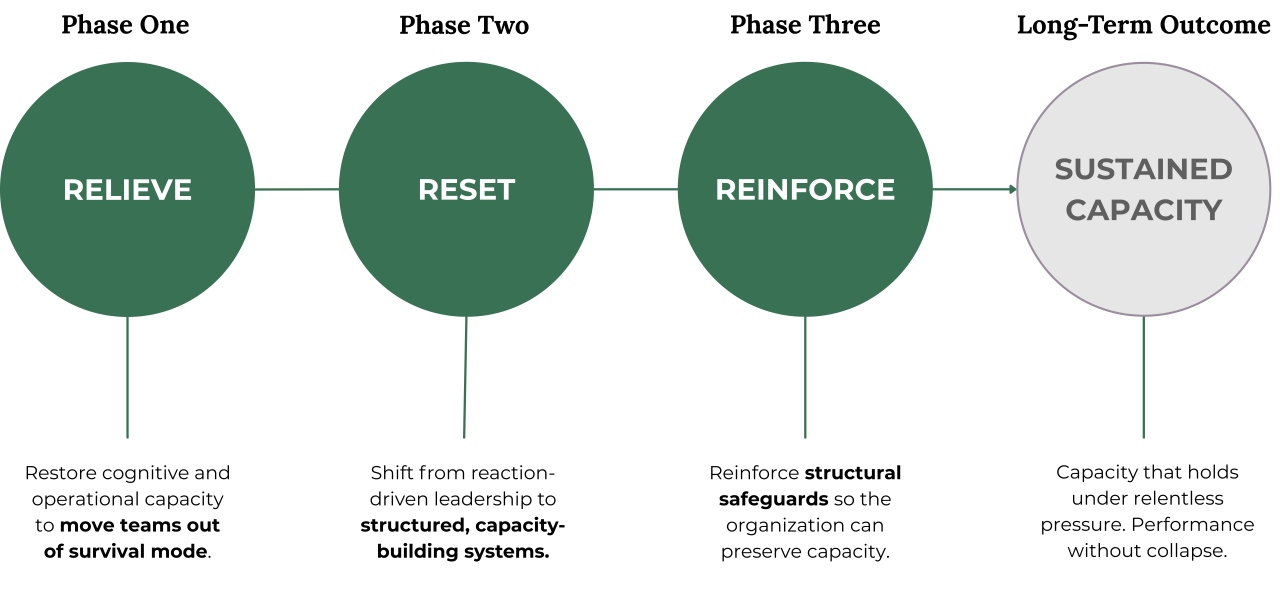
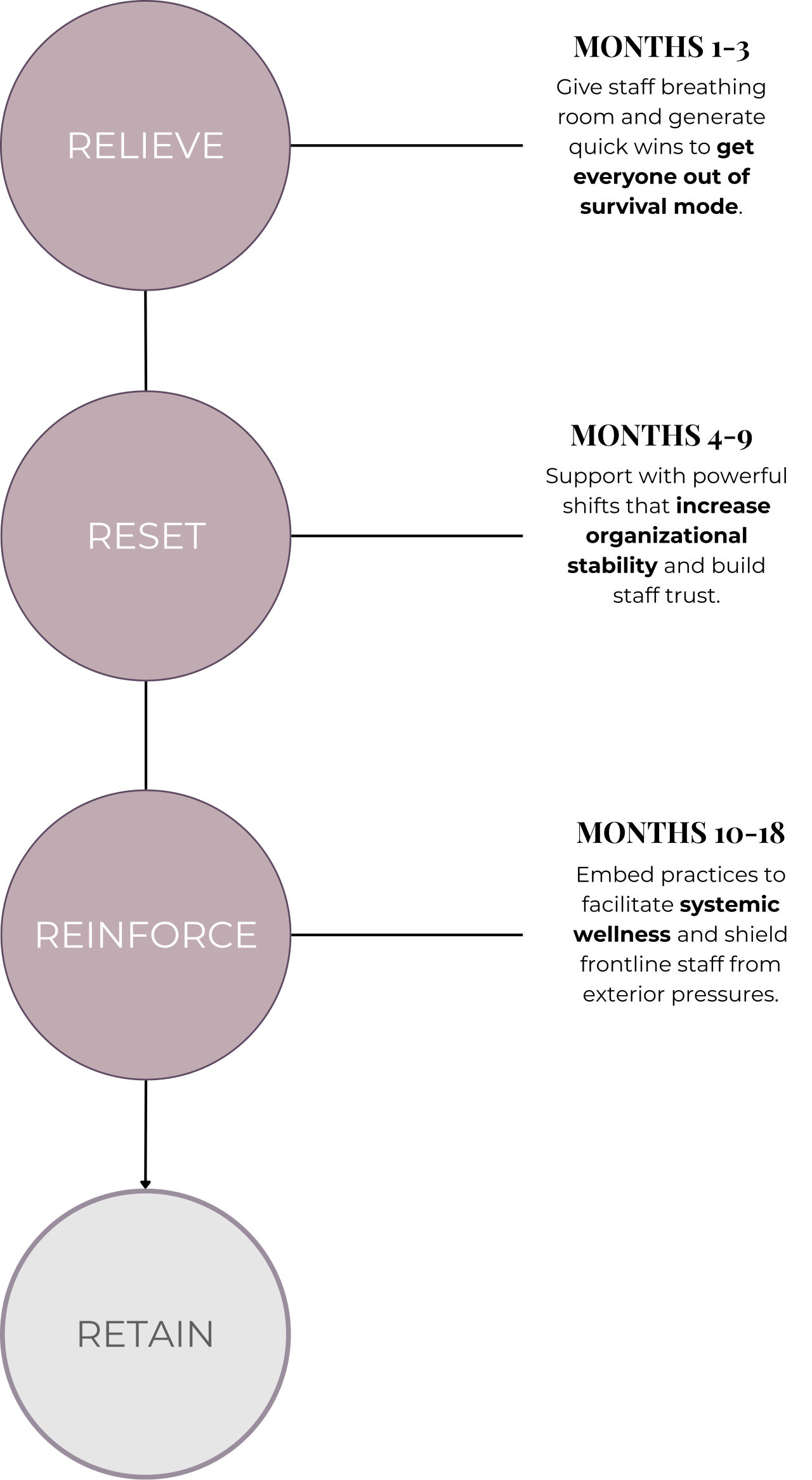
Relieve — Immediate Capacity Stabilization (Survival Mode)
Accelerated actions to reduce structural overload and create breathing room for durable change.
Most approaches fail because they don’t stabilize load under pressure before they attempt cultural change. (And if you struggle with staff retention, that's a constant pressure.) The Relieve stage is about creating structural capacity so teams can function with clarity, safety, and predictability.
Rapid wins that lower risk, restore morale, and ease turnover pressure.
Why it works: By creating quick, research-backed relief, leaders buy the breathing room needed for culture change. Staff regain the capacity to work, morale stabilizes, and turnover pressures stop escalating. By giving the entire team a framework for evaluating solutions, organizations avoid wasted initiatives, regain staff trust, and set the foundation for sustainable change.
Reset — Structural Capacity Rebuild
Learn how to rebuild culture by addressing the systems driving chronic crisis mode.
Phase Two rebuilds foundational structures — trust, psychological safety, workload clarity — so capacity gains hold long-term. Now that everyone has breathing room for change, we focus on the main drivers of retention and present sustainable practices that will help the changes stick for the long haul. This goes beyond buzzwords and into practical, tangible change you can see.
Why it matters: Research shows that unless root causes—like secondary traumatic stress, moral injury, and lack of psychological safety—are addressed, staff remain stuck in survival mode. Resetting culture during this stage builds stability, trust, and resilience, giving staff the confidence to stay and leaders the foundation for long-term retention.
Reinforce — Embedding Capacity Resilience
Sustain culture change with accountability frameworks, leadership supports, and future-focused systems.
Our last stage embeds capacity resilience through accountability frameworks, leadership strengthening, and future-focused systems so gains aren’t temporary.
Why it matters: Research on organizational change shows that transformation fails without reinforcement. This stage ensures that culture change becomes durable—so burnout prevention, psychological safety, and retention aren’t just initiatives, but everyday reality. Leaders shift from firefighting to future-building, and staff stay because they feel valued, safe, and supported.
Early Outcomes We Consistently See
- 85% of staff say they’re more willing to stay long-term after only four months of touchpoints.
- 96% of leaders report that the training is immediately actionable and helps them lead more effectively.
- Burnout pressures ease as staff feel supported and morale improves.
- Leaders get out of firefighting mode and gain space to focus on stability and growth.
- Peer support practices take root, giving staff daily relief and reducing isolation.
- Turnover pressures begin to decline, with leaders reporting stronger retention and fewer replacement costs.
The Staff Sustainability System™ Helps Leaders Turn Costs Into Savings.
Even modest reductions in turnover and overload translate into operational savings and sustained capacity.
Healthcare
Replacing a single physician costs up to $500,000 when you account for recruitment, onboarding, and lost productivity. Nurse turnover costs $40,000–$60,000 on average.
Healthcare leaders who worked with Five Ives reported:
- Improved quality of patient care as staff regain capacity to focus on patients rather than exhaustion
- Deeper organizational commitment to and readiness for addressing secondary trauma, creating safer, steadier clinical teams.
- Movement toward a healthier overall state of being for the workforce, allowing leaders to stabilize their teams and reduce costly churn.
Nonprofits
Replacing staff in nonprofits isn’t cheap. Turnover typically costs 20–30% of an employee’s salary—that’s $8,000–$12,000 for frontline roles, and often $20,000–$40,000+ for managers and program directors.
Organizations working with Five Ives have reported:
- Board and leadership teams with deeper awareness of how trauma impacts staff and clients, leading to stronger alignment between mission and operations.
- Staff showing greater willingness to stay long-term, which reduced costly churn and protects organizational knowledge.
- Improved service continuity, which strengthens client outcomes and preserves trust with funders.
Education
Each teacher who leaves costs you $20,000–$30,000 in replacement, substitutes, and lost classroom continuity. And a district losing dozens of support staff in a year can easily burn through hundreds of thousands of dollars in hidden costs.
The data shows:
- Teachers are more willing to stay long-term after only four months of touchpoints, reducing turnover costs.
- Stronger morale and trust, giving staff hope and energy to re-engage in the classroom.
- Improved social emotional learning outcomes for children, showing that when staff are supported, students thrive too.
Public Safety
Departments spend $125,000–$250,000 to replace one officer when factoring in recruitment, academy training, overtime to cover shifts, and the loss of experienced personnel.
With the Staff Sustainability System™, departments can:
- Stabilize officer wellness so fewer leave the profession early.
- Reduce overtime costs by keeping staffing levels more consistent.
- Strengthen community engagement and trust as officers have greater capacity to serve effectively.
- Free command staff from constant crisis management, giving them bandwidth to focus on strategy and safety.
Across every sector, reducing turnover even a fraction means massive savings — and a stronger, steadier workforce.
Next Steps
Got questions? Send them our way (jessica@fiveives.com).
Want a quote without having to get on a call? (It only takes two minutes for you.) Get a quote here.
Need that call? Schedule a no-pressure call with our team.
FREQUENTLY ASKED QUESTIONS
How is this different from other capacity building, staff retention, or wellness programs?
Most wellness programs focus on surface-level perks like appreciation events or one-off trainings. The Staff Sustainability System™ addresses the root causes of burnout and turnover with a research-backed, step-by-step framework that stabilizes staff and leaders in survival mode, resets culture, and reinforces long-term retention practices. Bottom line, this program is built for sustainable change, not one-time boosts that don't last.
We’ve already tried retention programs. What if this doesn’t work?
The system is designed specifically for organizations serving trauma-impacted communities — where traditional retention programs fall short. Our approach is phased, practical, and tailored so leaders see immediate relief within months while building toward long-term cultural stability. Simply put, if your team puts in the work, the program works.
We don’t have time for another program. How much time does this take?
This program takes just one hour a month. This time pays for itself because it reduces firefighting and gives leaders tools they can use right away to steady their teams. You can spend an hour putting out fires or an hour stopping them from starting in the first place.
How soon will we see results?
Most organizations begin seeing measurable improvements within the first few months — reduced turnover pressure, stronger morale, and staff reporting higher willingness to stay. Long-term retention gains come as leaders reinforce and sustain the practices over 12–18 months.
Is this only for frontline staff?
No. The Staff Sustainability System™ is built to engage leaders, frontline staff, or entire teams. Retention improves when everyone — from executives to direct service staff — shares tools, language, and practices for reducing burnout and building trust.
We already have programs tied to retention, like reflective supervision and trauma-informed practices. How does this tie in?
The Staff Sustainability System™ makes existing efforts work better — and in some cases replaces costly training altogether.
Many organizations already have strong practices like reflective supervision, trauma-informed care, or wellness initiatives. But applied inconsistently or in isolation, they can feel like “one more thing” instead of solving the core issue.
The Staff Sustainability System™ ties together the major levers of retention — trauma-informed care, reflective supervision, staff wellness, moral resilience, and secondary traumatic stress — into one cohesive framework that reduces the drivers of chronic crisis mode within the organization.
Most importantly, it gives leaders the structure and timing to know when and how to use these tools so they stick and deliver measurable results.