Stop Running on Heroics.
Start Building Capacity.
When demand is relentless and your team is stuck in crisis mode, effort alone won’t stabilize the system.
We build the structural capacity high-pressure organizations need to operate with reliability under sustained demand.
Does constant crisis mode feel "normal"?
Everything feels urgent.
You’re constantly putting out fires with no margin to think.
You’re making no-win decisions daily.
You’re one resignation away from real instability.
You can’t step away without something slipping.
You don't remember what it's like to not be burnt out.
Sound familiar?
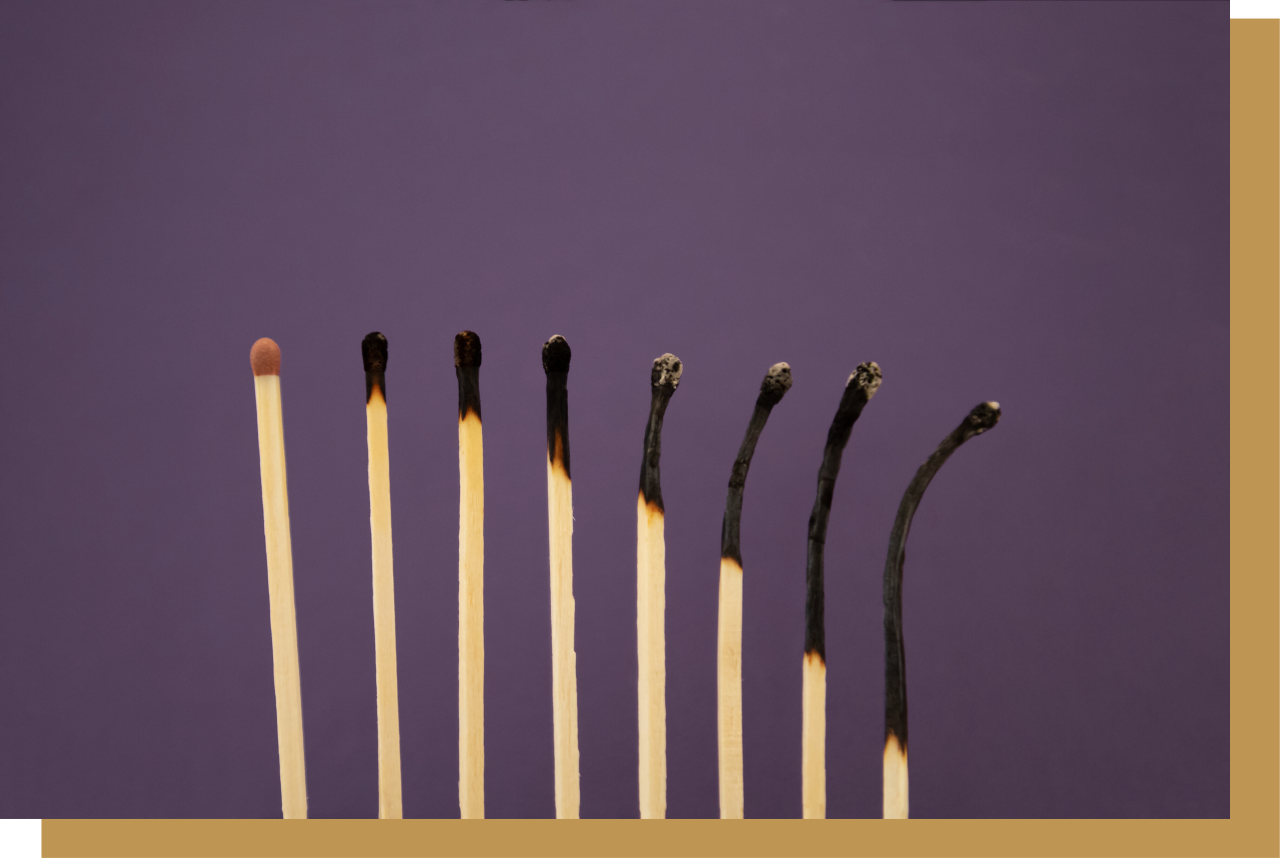
This is what sustained pressure looks like when systems aren’t built to carry it.
Take our free assessment to see where pressure is concentrating (and what to stabilize first).
Most burnout solutions fall short. (But there is hope.)
resilience and self-care workshops,
staff wellness initiatives,
time management training,
But when sustained demand exceeds structural capacity, no amount of effort, training, or motivation will stabilize the system.
High-pressure organizations need systems built to absorb stress, distribute load, and prevent chronic strain from routing through people.
See the structural approach we use instead →
What Actually Builds Workforce Stability
And Gets You Out of Crisis Mode
You can't make the pressures or demands of the job go away. But you can change how they are carried within the system.
Workforce stability under chronic pressure does not mean finding ways to do less. (We all know that isn't usually a realistic ask.) And it isn't about just taking a deep breath or a bubble bath. (No amount of "self-care" is going to change the relentless pressure you face.) It’s about building structural capacity to carry more without collapse.
High-pressure teams stabilize when they:
- Stop absorbing pressure silently at the frontline and correct where it actually originates.
- Break recurring patterns that keep the same crises resurfacing week after week.
- Remove ambiguity about who decides, who enforces, and who follows through.
- Take moral and policy weight off individual staff and place it where it structurally belongs.
- Build systems that hold when leaders are tired, absent, or replaced.
- Embed trauma-informed care into authority, supervision, and workflow — not just training days.
That kind of stability doesn’t happen by accident. It requires a deliberate system for diagnosing pressure and correcting how it’s carried.
You can meet the relentless pressures without collapse.
Here's how.
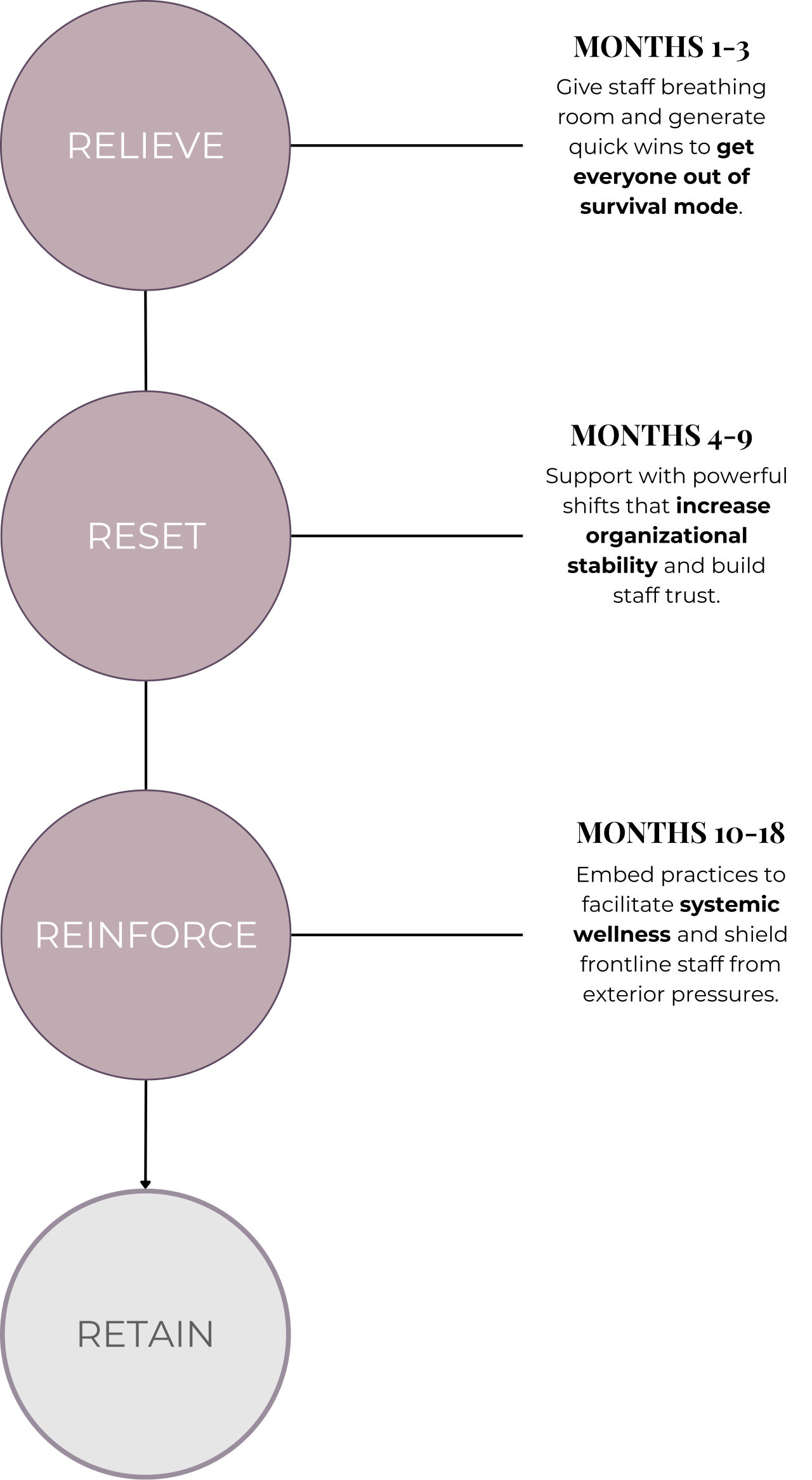
We map where pressure is being generated and where it is landing — across leadership, frontline roles, policy demands, and workflow design. From there, we apply interventions proven to stabilize even the most chronically stressed and stretched teams:
- Immediate stabilization to reduce acute strain.
- Structural correction where recurring instability is rooted.
- Reinforcement mechanisms that ensure progress holds under turnover, growth, and continued demand.
This is not a one-hour training. It is a staged, system-level intervention designed to increase capacity in high-pressure environments.
That’s the Staff Sustainability System™.
What are the Five Ives™? (We're glad you asked!)
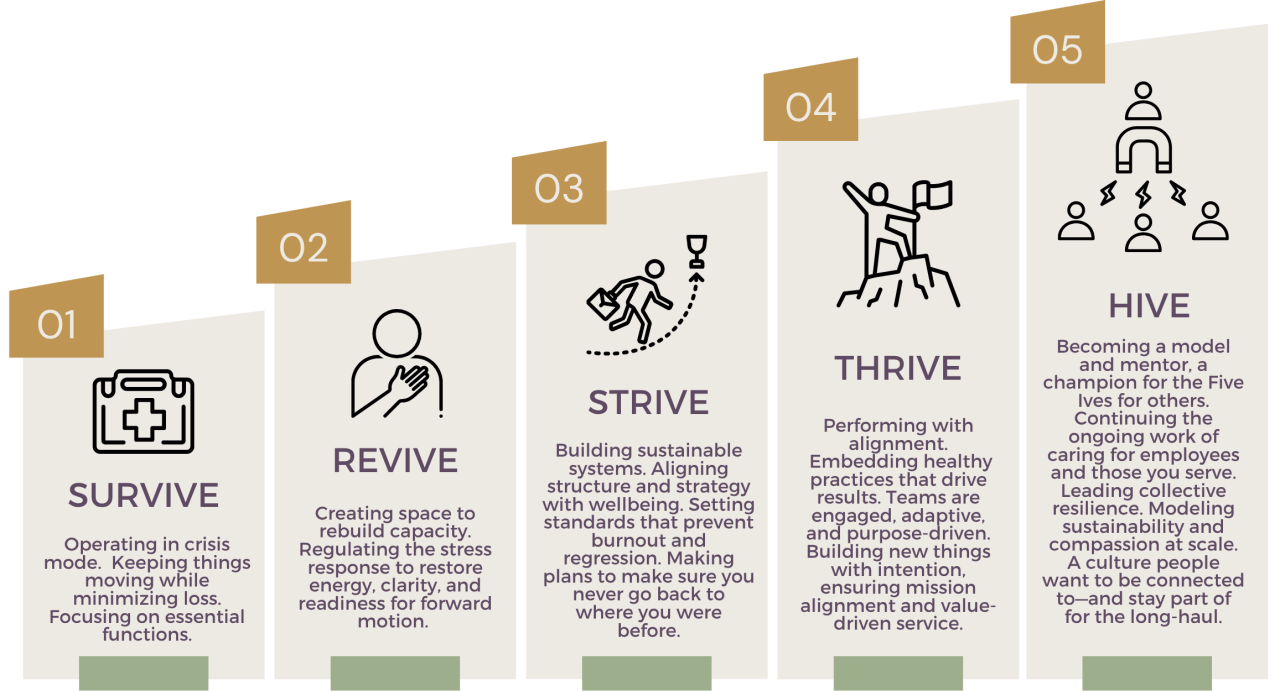
The Five Ives™ Framework is our proprietary research-backed model that maps the journey from crisis to sustainability across five universal stages.
This progression gives leaders a roadmap to know when and how to implement systems, initiatives, and strategies — avoiding the trap of one-off trainings and interventions that don’t stick.
It’s not about adding “one more thing.” The Five Ives™ help organizations know what will actually work in the moment they’re in.


- What is Five Ives™?
- Five Ives™ is a trauma-responsive workforce sustainability consultancy serving high-pressure organizations across healthcare, behavioral health, nonprofits, education, public safety, and legal services. We deliver the Staff Sustainability System™, a staged, system-level intervention that builds the capacity for teams to operate reliably under sustained demand.
- Who does Five Ives™ work with?
- Executive directors, chiefs, VPs of HR and Operations, and Training Managers inside trauma-facing organizations. Our work has reached state primary care associations, community health center networks, behavioral health organizations, and statewide child advocacy leadership across the United States.
- How is the Staff Sustainability System™ different from burnout training?
- Burnout trainings target the practitioner. The Staff Sustainability System™ works at all four levels where burnout originates — Policy, Practice, Practitioner, and the People served — through three structured phases: Relieve, Reset, Reinforce. Engagements run over months, not hours.
- What outcomes has Five Ives™ produced?
- Leaders rate the work 93–96% satisfactory and 100% useful for their day-to-day operations. Across multiple cohorts and fields, 85% of frontline practitioners say they are more willing to stay in the profession long-term because of the work done with Five Ives™. And every client Five Ives™ has worked with has either renewed their engagement or referred new business.Five Ives™ produces outcomes at every level of an organization — from how practitioners work to how the people they serve respond.Healthcare and behavioral healthAcross healthcare and behavioral health cohorts, 176 leaders rated the training immediately useful, with 100% reporting they could apply the material directly to their day-to-day work. Practitioners adopt the material immediately, which is what makes it hold.Early-childhood education pilot
- Every classroom that completed the program reached high fidelity in trauma-informed teaching practice (Teaching Pyramid Observation Tool) across two consecutive years, compared with fewer than half of non-participating classrooms.
- Children improved four times as much as the comparison group on social-emotional screening (ASQ:SE-2) in a single year.
- 90–97% of children met or exceeded social-emotional expectations on Teaching Strategies GOLD.
- What is the Capacity Squeeze Map™?
- The Capacity Squeeze Map™ is a free organizational assessment that shows leaders where pressure is concentrating across their team and what to stabilize first. It is built for executive leaders in trauma-facing organizations and takes about ten minutes to complete.
- Do you offer one-time trainings or keynotes?
- Our core work is the Staff Sustainability System™, a multi-month engagement designed to change how pressure is carried inside a system. We take paid keynote and speaking engagements, and our sustained engagements make change long-lasting, so we scope one-off sessions as keynotes or custom formats rather than as a stand-alone fix.